Calzona Coming Soon asks tough questions about what happens when there are competing or misleading visions for a piece of land, which in this case is that of an antiquated subdivision.
When land is sold, based on false promises at best or fraudulently at worst, as in the case of Calzona, what is there to preserve? Should failures of U.S. real-estate law be preserved, curated, and presented critically as the Calzona Collective seeks to do? Or should the land fulfill the promises with which it was originally subdivided and sold?
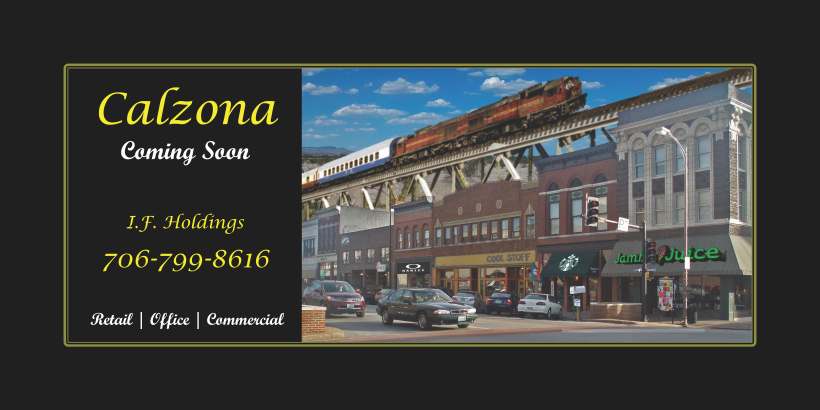
Calzona Coming Soon takes the physical form of a banner advertising the development of buildings resembling a downtown strip mall, photoshopped and superimposed over a photograph of present-day Calzona. It plays on tropes of gentrification from examples such as Chicago and San Diego. The banner is meant to be displayed onsite to create a stark contrast between the real and envisioned versions of Calzona.
The photocollage on the banner is pieced together from several source images in a way that purposely uses common mistakes of photoeditting, namely multiple vanishing points and light sources, to communicate the distorted nature of the visions that are used to sell land. The image in context, along with the viewer’s perception that someone cares enough about Calzona to display a vision for it, draws attention to the original vision for the land, and how far it is from reality.
However, if one were to “revitalize” Calzona, it would be covering up a historic failure of U.S. policy, in a way gentrifying it. Calzona may a limited community of permanent residents in Calzona, but its fraudulent history is what makes it Calzona.
An essay reframing traditional spacemaking ideologies at the intersection of art and social engagement.
About five hours east of San Diego sits a town brimming with possibility. Amidst the scorching desert heat and a beautiful sense of isolation, the unincorporated territory of Calzona, California calls itself home to two men, a dog, and a quasi-imaginary marijuana dispensary. Long dirt roads leading nowhere seem to wind endlessly toward the horizon, and dry dust permeates the air. With nothing but arid desert for miles around, Calzona seems to have an atmosphere that invites a calm sense of isolation. It seems impossible that an abandoned and antiquated subdivision (with an estimated population of two) could epitomize the idea of a landscape full of possibility and hope. However, in rethinking the ideologies of “possibility” and “value” as they are attached to the capitalistic economic system, the empty town of Calzona reveals itself as a space with value that transcends that of the commercial. While land in Calzona is worth almost no money, its true worth lies types of possible futures that the land itself imagines for us.
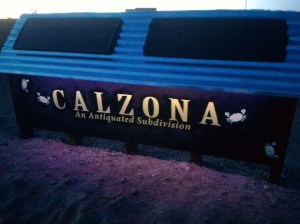
Brett Stalbaum and Paula Poole, A subdivsion sign for Calzona, CA. Solar Station and power system for various projects and experiments requiring compute.
An essay by collective members Brett Stalbaum and Paula Poole
It was an examination of works by eteam – artists that some of us have known of for some time – that framed the development of the Calzona Collective. Over a decade ago eteam explored the new kinds of marketplace that ebay had enabled, but using frames of reference that only artists can enable or possibly anticipate. Purchasing site unseen – except by raster – some land in the deserts of the American West, then going there and conceiving of an “artist residency program” to conceptually improve the landscape and – flip it.
“Flip it” is not eteam’s term. It is part of the the parlance of a large number of Americans who buy and sell real estate. Flipping is the practice of buying a property, maybe fixing it up, but in all cases reselling it relatively quickly for a profit. Beginning in the early 2000s, flippers became the marks in a confidence scheme led by Wall Street that would famously crash the world economy by 2008. Flipping real estate through sub-prime loans was a pathway to wealth, albeit without the effort required to be a participant in the emergent knowledge economies (recently renamed the “Blue State Model“) of our time. Before the 2007-8 crisis overseen by U.S. President Bush II, real estate speculation had appeared as lucrative as what became known as the Pine Barrens Speculation of 1789 to 1796 once did. After the Pine Barrens disaster, claimants were left to sort out property titles for a generation. After the sub-prime loan scandal, those who took out the various adjustable rate mortgages and “liar’s loans” were left holding the debt and often driven into foreclosure if not bankruptcy, all while Wall Street got handsome bonuses. Indeed in the Calzona Collective’s studies, we found that the scoundrel ridden world of real estate speculation goes all the way back to the founding of of the United States. (Professor Ross H. Frank of UCSD’s department of Ethnic Studies turned us on to the Marshall Trilogy.) Donald Trump’s “Trump University”, a real-estate related fleecing of yet more hapless marks that became of some concern during the 2016 U.S. presidential contest, is simply nothing new in a historical sense. More often than not, the Trumps, the Wall Street Bankers, the Neil Bush types, the Andrew Jackson’s of our history; all of them get away with their depredations without much if any penalty. In their wake rests historical manifestations such as the Trail of Tears, Swamp Land in Florida, the 1980’s Savings and Loan scam, and the Sub-Prime mortgage crisis that led to the Great Recession of 2008. Same as it ever was. A nation founded on real estate fraud.
In eteam’s 1:1 Acre Flat Screen, the present authors who would later help found Calzona Collective were happy to play along with a parallel practice of real estate speculation under the alternative terms that eteam had first spotted across the digital horizon, using their web browsers as periscopes, thus re-configuring the newly “clickably liquid” (our term) marketplace for speculative land sales into a prescient pre-critique of the Great Recession. There is a land art of the 21st century, and this is what it looks like. Today we can see eteam’s project as a clear and prescient parody of something terrible – for most people – that was still brewing in the near future as the parody was written. But for all of that weight, it was nevertheless exciting to play along. In all of their work, no matter the sometimes depressing conditions underlying it, eteam also understands dopamine: the direct the neuronal joy of digesting novel landscapes, of exploring and understanding these places and making friends with the people who inhabit them; all in a lovely, kind and clever way that unpacks location in ways not unpacked before, and sometimes is even capable of bringing a forgotten desert airstrip back to life – conceptually at least!
Paula Poole at work near eteam’s Bergblick site, Utah, 2002.
And that brings us rather indirectly back to the land use disaster known as Calzona. Calzona is an official place name in the USGS gazetteer, a portmanteau created from the U.S. states of California and Arizona. Calzona lies on the California side of the Colorado River that generally represents the border between the two states, just south of the communities of Big River (CA) and Parker (AZ). There is a lot to talk about here that for reasons of space, must wait for other publication. But the American (read U.S.) legacy of chopping (the legal term is “subdividing”) land into units that are useless for any reasonable economic purpose, other than perhaps real estate scams of course, describes the Calzona area well. Calzona includes hundreds of 5225 square foot lots, not large enough to justify individual water wells, and insufficient in size for individual septic systems. The lots would barely fit a mere double-wide manufactured home! Yet in the early 1970s, these were created as taxable lots complete with APN numbers and an annual property tax bill from the county of San Bernadino. Other lots in the area are larger, but our neighbors report natural arsenic in their well water. A few people do live in the area: nominally tough desert people with otherly life stories to tell, but who are also somewhat isolated from society, sometimes stoned, we think, totally reasonably so. (The essay’s title does not refer to THAT kind of recovery.)
The Cannabis Sanatorium Institute – and one of the Calzona area’s few existing signs in 2015
One of the first neighbors we met in Calzona threatened us with a gun – importantly – a gun that if it actually existed (probably it does) was never actually produced, brandished or displayed to us in any way. Being of the American West ourselves, the present authors are also white Americans long engaged in gun culture, so we fully understood this rhetoric as completely sincere, but not dangerous. Quite a few others among the collective would understand this firearms related scenario regardless of race, having grown up in the desert, having grown up around guns, and otherwise having spent much time in the U.S. western outback. We hold no kind of grudge, that is just how the Western deserts are. Quite to the contrary, we became grateful for the thought of having neighborhood eyes and ears who care about the place! This is to make a corollary point: many of the lots in Calzona have presently negative economic value – the annual property taxes cost more than some of the lots were legally acquired for! And when you let that kind of land use disaster happen thorough your planning and zoning policies, the people who most often turn up physically as actual visitors to the actual territory are those who do not hold title to the lands, and frequently these folks have a much less respectful attitude toward the landscape. They are trespassers (often on dirt bikes and ATVs), illegal dumpers, sadly some shooters who don’t know how to behave, and other rapscallions. Our neighbors who actually live in the landscape full-time are far outnumbered by these kinds of informal guests, and are right to be concerned with outsiders, because outsiders often bring with them destructive and annoying behaviors.
This being remarked upon, other guests to the region are the occasional true believers (flippers who still believe in buying low and selling high, which is absolutely hilarious in the Calzona context), and as the Calzona Collective is working to stimulate, artists. It is artists who often play the role of first-wave gentrification in other contexts, but we think the arrival of the arts in Calzona is probably not such a sign. At least it is not a sign of gentrification qua bringing residential and business development, or economically displacing the neighbors. But it does bring some new neighbors who care about the place. It is important to note too given the above reference to the present writers’ whiteness, that the Calzona Collective is actually very diverse and international, consisting of professors and students from around the globe. China. Taiwan. Spain. U.S. Brazil. Mexico. So our early experience with meeting the neighbors as described above simply happened that way because the present writers are among artists who first owned land in Calzona; again it is understandable to be suspicious of outsiders, but only as long as they are outsiders. Noting also, not many students or young people have the resources to spend however modestly on the acquisition of negative value lands! Unsurprisingly and in marker we take as progress and health, the diversity of the collective admittedly comes in large part through our students, and we do hope those diverse perspectives will balance our own. The present writers speak for the collective only insofar as we are able, and if there is a discursive voice to the collective, all the better. This writing is not a “manifesto” or something that all of the founders sign onto, nor does it need to be.
So, that is some approximation of where the Calzona Collective is, figuratively, literally and discursively. We know this place is full of rich cultural value, even if much of that is found in a histories of sadness, regret, and even internment. But there is a hopefulness too.
What value can art and design discover in these kinds of places? What technological and social interventions can activate these spaces beyond their current status as – at best – poor planning decisions? There is wild environment there – plants and animals who continue to occupy these lands because the earth here is of little to no practical use to humans (other than the profits inherent in various confidence games and land scams.) Maybe the sunlight shining (again figuratively and literally) on these failed micro-parcel desert landscapes can become the energy sources of Calzona’s future! Maybe humans can learn to re-engage with nature without the soft handrails of interpretive trails, traffic jams in national parks (traffic included in the price of admission), or warning signs for stupid people regarding taking selfies too close to bears or the dangerous edges of cliffs. Maybe the puritanical fear of the sweaty human body, or the weakness evident in those who fear life without air conditioning, maybe these are things that our a tougher-by-necessity millennial generation can crush under foot? Calzona’s older generation can only hope.
Or maybe we can all – no matter age or background – just laugh. This is what we are obviously interested in: recovery, and sometimes laughter is a powerful cure. We also indexed a little of the Dionysian or otherwise happy making sensibility when we discussed eteam’s spirit of learning about and working with the people in places that are obscure, yet interesting for it. The Collective certainly had fun completing projects together on May 21st 2016, channeling eteam’s sensibility having studied their work in some detail. A China Town. A Bus Stop. (Ok, Uber stop.) A recycled garden. In various attempts of certainly variable effect, we are working to repair the foolish mistakes of generations that have preceded us, even if it is with some our own joy along the way. Hard problems, these are the best problems! The easy answers repetitively mouthed by aging idiots (and also by the aging powerful who who are increasingly losing control of “their” idiots), none of this is any longer to be favored. Sometimes it is best just to try things, see how they turn out, laugh. Analyze. Critique. Iterate. Write and rewrite. Artists get to work that way; a unique privilege of the arts as vocation.
Given a world that has left an entire younger generation with an inheritance of problems, angst, failure, distrust, and general clean up duty following those baby boomer Woodstocks and Burning Mans, we hope most of all that we can create an art that discovers whatever life, peace, isolation, environmental balance and justice that is still possible to find in the spent and relatively valueless, yet ironically really expensive, world that remains to millennials for sorting out. Calzona is an excellent testing ground to do research on what is left to be recovered from all of the economic and environmental destruction that are being left to upcoming generations. It is at least the possibility of intervention in the waste lands left behind, which we view as a step up from debauched consumption in precious BLM wildernesses.
Calzona is a multi-generational, mostly accidental laboratory for discovering what can be made out of whatever remains. It should be added, that the Calzona Collective is open to contributions to the space from others who might become neighbors. From our perspective they do not need to adhere to anything stated here or elsewhere, as that would obviate our desired experimental attitude toward land use.
on the desert, what we can build and what desert need? So I create green, a plastic garden on my site.The idea of sculpture are based by both data visualization and recycle and the concept of project- whether doing event or touring , can we have more ways to leave or dispose trash.But, what kind of material I can use when we trash most on desert? As name of project, It will be made by plastic. But where does plastic from? Finally, I think the recycled bottle can be my material after we drink inside of water As similarly, human society use plastic bottle to store water and cactus use its highly-modified leaves to conserve water.As the same time,some of them’s appearance would base on the average precipitation of local area.So,the heights of first three plants was based on most 3 months of local average precipitation in one year.
I make more types of plants that make my site to be a various garden on the desert.How make the end of project that still let me considering? abandon or recycle them as normal trash. Or pick up them to do more things as promoting my idea.
The winners of the Calzona Prize will be announced, and receive their award in person during a presentation/ceremony event beginning Monday June 6th 2016 at 4PM, on the UCSD main campus, graciously hosted by the Department of Visual Arts in Room VAF 228. Recent developments and projects at the Calzona site will be presented by members of the Calzona Collective, and a film by UCSD Media BA graduate Felipa Gonzalez will also be premiered. The public is invited to join us!
It’s hardly an exaggeration to say that it sprang out of the desert on one spring night. The barren red pavilion stands proud and alone amidst the endless creosote bushes. What does it mean? Where did it come from? The answer lies with a people long gone from the site.
For each of us, it meant something different. A tribute to the strength of people united, a desire for an anomaly in the uniform landscape, an expression of heritage — whatever it was that drew us together, in the end we all had the same pride when we looked at the fruit of our labors. We’d been dreaming of Chinatown for nearly a month, but when the time came to build it, the anxiety quickly settled in. Rome wasn’t built in a day, but could Chinatown be? The answer remains in the desert.
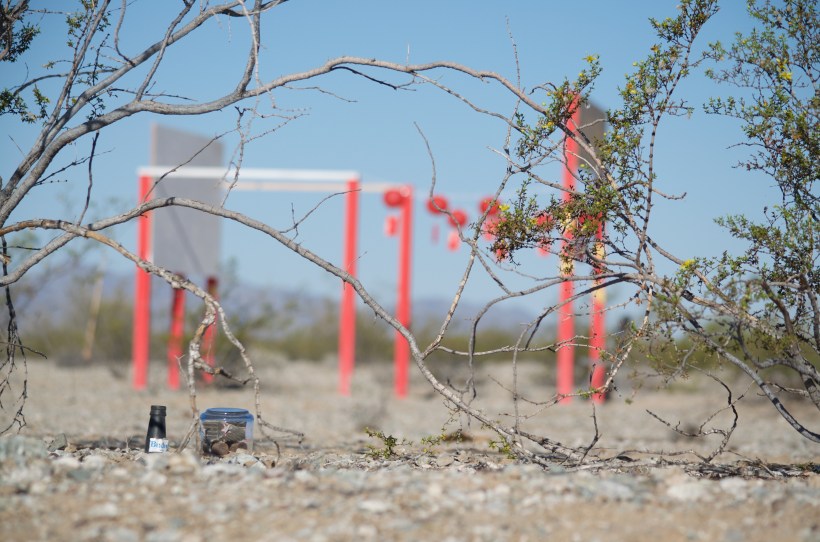
Chinatown is also planned as a permanent video installation, but it first functioned as a performance context for a single night. The new landmark plays with the idea of civilization in a remote setting. The concept of a “Chinatown” in the desert plays with the cultural meaning of these iconic places throughout the world, which typically feature an antique style gate, dragons, lanterns, and a lot of red. This installation functions as a “miniature” version of a Chinatown; there are no real shops, no restaurants, no visitors, but by using projection, a “virtual reality” of sorts is created. For the night, a projection of real street views of Chinatowns was shown the structure, with the festival Chinese music and street sounds playing in the background. There was also a screening of Siyi Ye’s emoji project which examines related questions of racial representation and related semiotics: racially representative emojis entered into this examination of race, culture, and history of the California landscape, tying the typology of a Chinatown to contemporary networked representations of the same issues.
Though the physicality of Chinatown was not there, the spirit was. Whether the projection included Chinatown streets or emoji artwork, the idea of a gathering of people, bound by cultural significance to a small area of the world, was what fueled the performance. This concept is inspired by similar desert performances such as eteam’s International Airport Montello or Bob Dornberger and Jim Piatt’s Full Moon Ramen at Secret Restaurant, that play on the isolation and absurdness of its location while relying on viewer presence and participation to create “place” in the desert.
Chinatown also serves as a tribute of sorts to the Chinese Americans who have managed to make their way in adverse environments, whether they worked among an unforgiving landscape or a wary neighborhood of xenophobes. Often the two were not exclusive. There is a long history of discrimination against Chinese Americans, yet they were able to create opportunities only in such harsh physical and social climates. Despite such obstacles, Chinese people endured, expanded, and built homes away from home—Chinatown. It wasn’t the first time that a Chinatown arose out of nowhere, and it likely won’t be the last.
For my individual contribution to the Calzona Collective site, I created a mini terrarium enclosure, a micro-plot of the land. This miniature self-contained unit of land will be the first of many—with each to added upon later follow-up visits to the site.
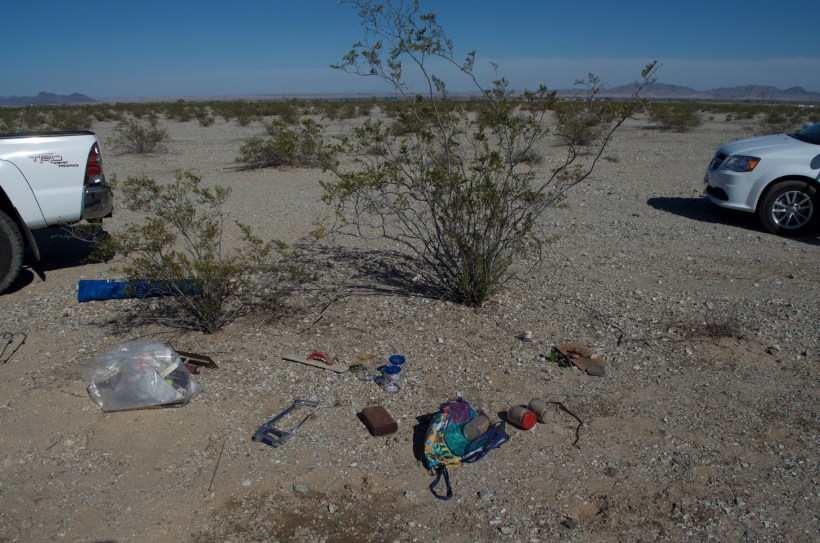
In making this terrarium I wanted to highlight the characteristic details that make up of the land around the Calzona area. I decided to make my project a bit investigative; rather then bringing out pre-fabricated and assembled materials to the site, I decided to go with a bit more subtle approach. I would only take my containers and photography equipment out to the site, and I would look around the desert site to acquire materials that I would use to building my miniatures. For about an hour or so I walked within a few hundred yards of the site, finding an assortment of thrown away objects that I would use. By using objects that I found I wanted to give my project the little details that made up the particular characteristics of Calzona. After gathering these materials I spent the next bit of time collecting the different types (colors) or dirts that I could find. Using all of these found objects I then created my miniature Calzona plot, this one left at the site for instance is a mini-trailer made of wood, shotgun casings, and discarded wrappers. And in true Calzona fashion, several of the future micro-plots will be named, divided, and sold on eBay.
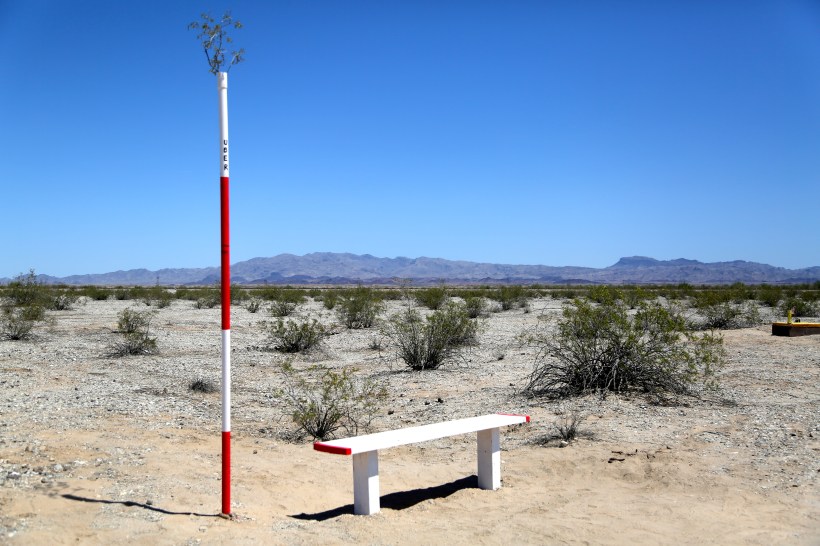
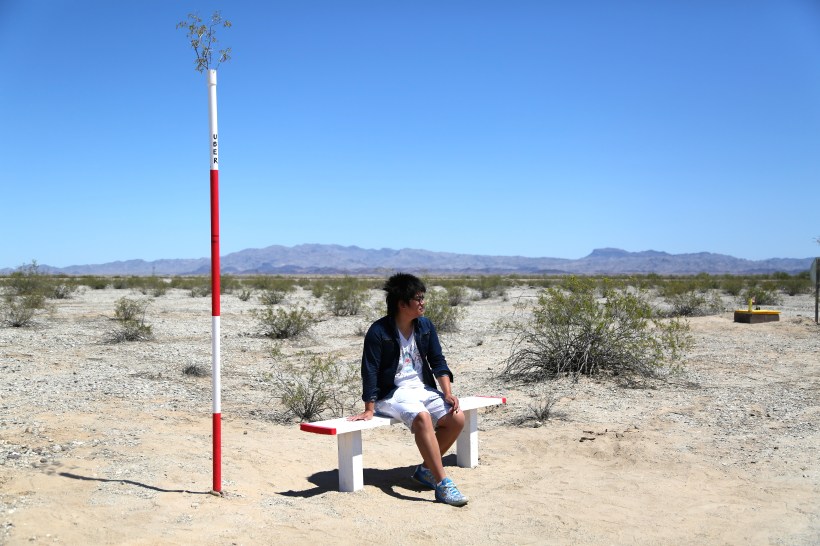
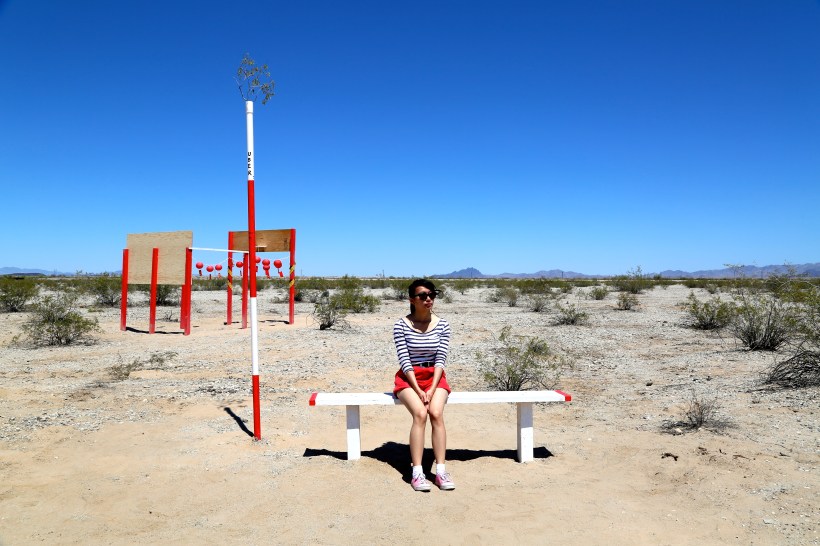
This art installation located in the deserted area of Calzona in California, consists of a pole and a bench representing a pick up and drop off location for Uber passengers.
This piece illustrates the desolation and lack of transportation of some areas in California where people reside. It becomes a symbol of connection with the rest of the world and a representative sign of the implementation of technology in art and in the environment as a it portrays how new mobile phone virtual applications, like Uber, are changing physical environments and the way society functions. The intention is to make the viewer doubt about the potential of such a strong and sophisticated network on penetrating such a remote area of the country. In addition, the choice of materials and colors for the installation were very simple in order to promote the complexity of the invisible and impalpable of such life changing movie phone applications.
Also, the art installation promotes the colonialism of Uber by including a promotional code (7np4wdtuue) written on the pole that can be redeemed as $20 credit cash for Uber rides.
A chair sits in the middle of the desert It is said to be a laughing chair Mysteriously at night In the vicinity of the chair A continuous laugh is heard over the airwaves (87.9 fm) No one knows why Only rumors passed down Some say it is haunted Tales migrate on the desert wind El que se rie cuando le da la gana He who laughs when he wants
In the barrens of an unfulfilled desert home site at the periphery of small town, Big River, CA. adjacent both the Colorado River and the Arizona border, nestled amongst sand and pebbles emerges a wrought iron sign that announces the existence of a laughing chair. Beyond this marker sit two institutional blue plastic and metal chairs horizontally separated and facing the viewer as if at attention to some instructor’s lecture. Slightly behind these seats and through their horizontal separation sits another institutional chair. This one however, is orange plastic, metal, and contains an attached wooden desk arm. Most significantly this seat faces the opposite direction and/or turns its back to the viewer in a somewhat defiant gesture and separation from the adjacent chairs. This is the outcast, rebel, and castigated member of the ensemble whose incessant laugh is heard over the airwaves of the radio once the sun goes down. The broadcast is in the vicinity of the site on an FM station (87.9) near the end of the dial. This is the laughing chair that is described in a short Spanish language film at the Calzona Art Site. El Que Se Rie Cuando Le Da La Gana is a land art performance installation that joins the circuit of folktales of the American West and specifically the Colorado desert region. This work was inspired by a mixture of personal instances, the spirit of the desert, and the popular myths that circulate like those of the Chupacabra, La Llorona, and Bloody Mary whose presence are made known through passed down tales carried on the breaths of believers and non-believers alike. El Que Se Rie Cuando Le Da La Gana or “He who laughs when he wants”, is the embodiment of rebellious individualism or those who have chosen not to conform to the norms and structures imposed by societies upon their inhabitants at large. They who have expressed the fortitude to choose their own voice and path as have so many ‘a wild character’ who has planted their roots amongst the harsh vastness of the desert landscape.
El Que Se Rie Cuando Le Da La Gana, Alexander McVickar, 2016, Calzona, CA.


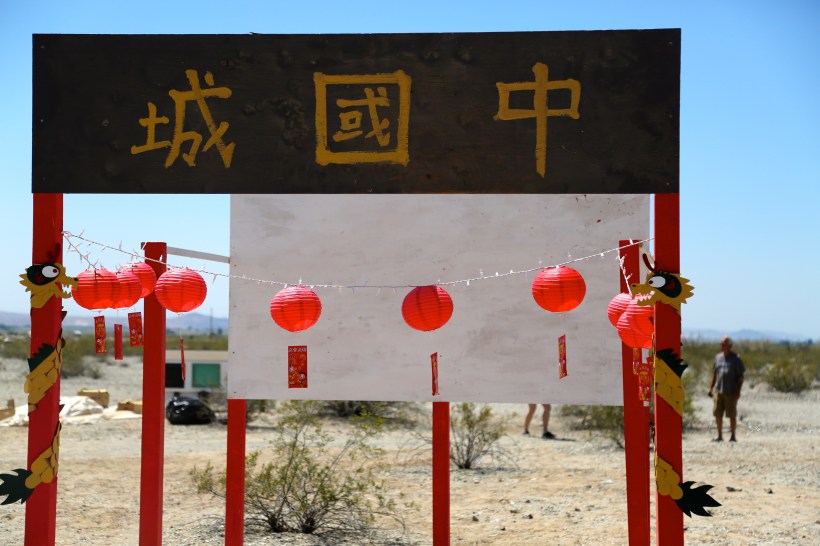 It’s hardly an exaggeration to say that it sprang out of the desert on one spring night. The barren red pavilion stands proud and alone amidst the endless creosote bushes. What does it mean? Where did it come from? The answer lies with a people long gone from the site.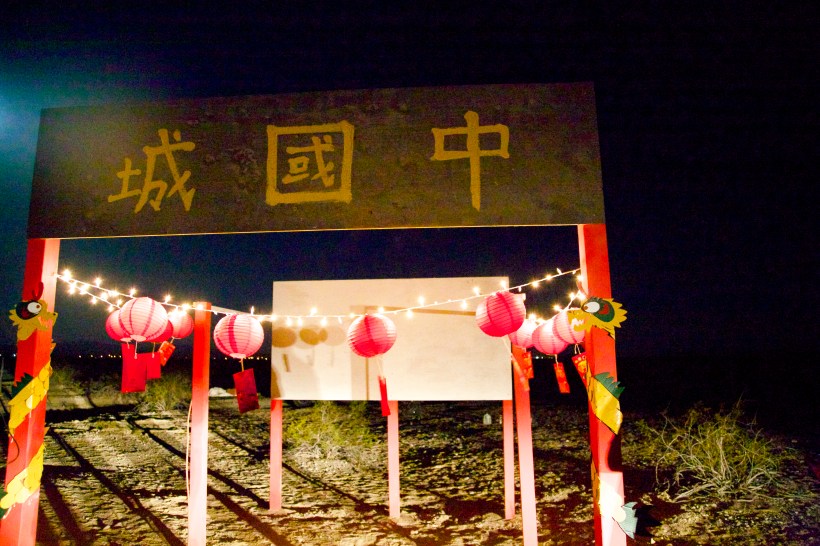


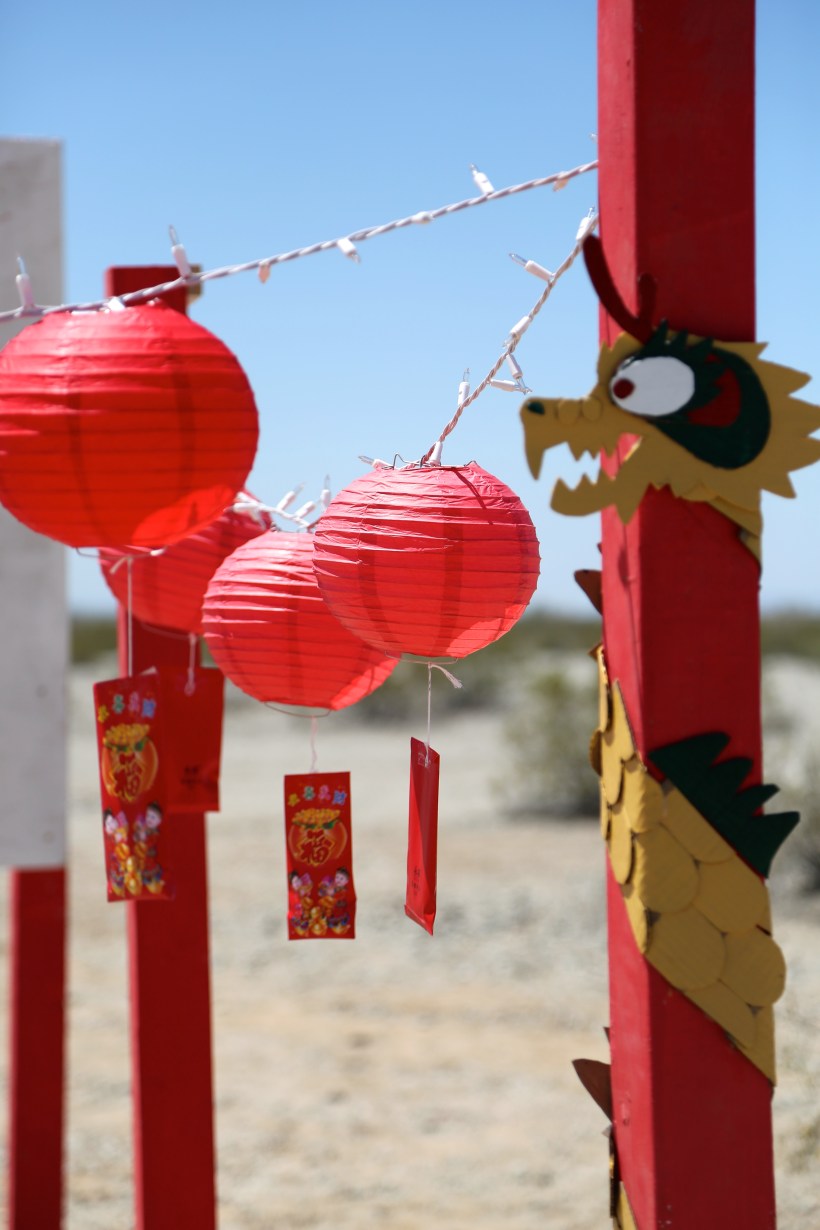
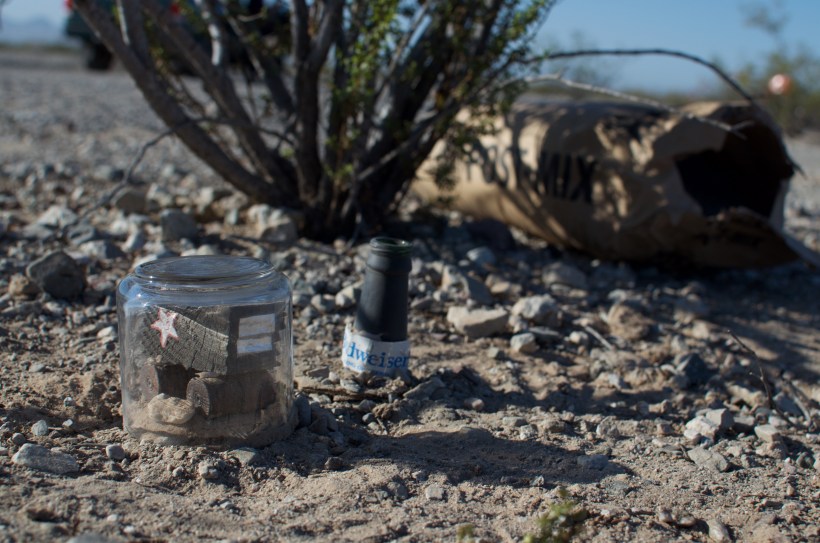

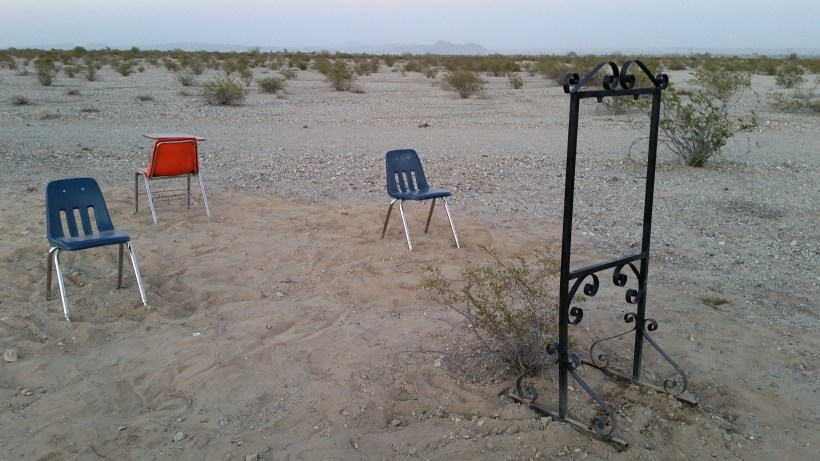
 El Que Se Rie Cuando Le Da La Gana, Alexander McVickar, 2016, Calzona, CA.
 THE CALZONA COLLECTIVE